
Call us on 01707 385 226

China Top Foot And Ankle Brace Manufacturers?

Choosing among China’s top Foot And Ankle Brace manufacturers requires more than comparing factory prices. It demands evidence of material quality, testing discipline, design experience, and reliable after-sales support. Grand View Research’s 2024 report on the orthopedic braces and supports market identifies sports injuries, aging populations, and rehabilitation needs as major growth drivers. Fortune Business Insights reports similar expansion, while highlighting patient comfort and product innovation as important purchasing factors.

The market is growing. Quality is uneven.

A credible manufacturer should explain how its braces control ankle motion, distribute pressure, and maintain comfort during extended wear. Practical details matter. Look for breathable neoprene, reinforced stitching, adjustable straps, accurate sizing charts, and documented product testing. Manufacturers serving hospitals or professional sports teams may also provide traceability, quality-management records, and compliance documentation for target markets. These details do not guarantee perfection, but they reveal operational maturity.

Dr. Emily Splichal, a podiatrist and human movement specialist, often states, “The foot is the foundation of the body.” Her observation supports a central point: an ankle brace should work with natural movement, not simply restrict it. Buyers should still question broad performance claims, because some reports combine different orthopedic products within one market category. That limitation matters. A careful supplier comparison should examine clinical feedback, production capacity, customization options, defect rates, and independent test results. The best manufacturer is not always the largest one. It is the partner that can demonstrate consistent quality, communicate clearly, and improve when a product fails in real use.
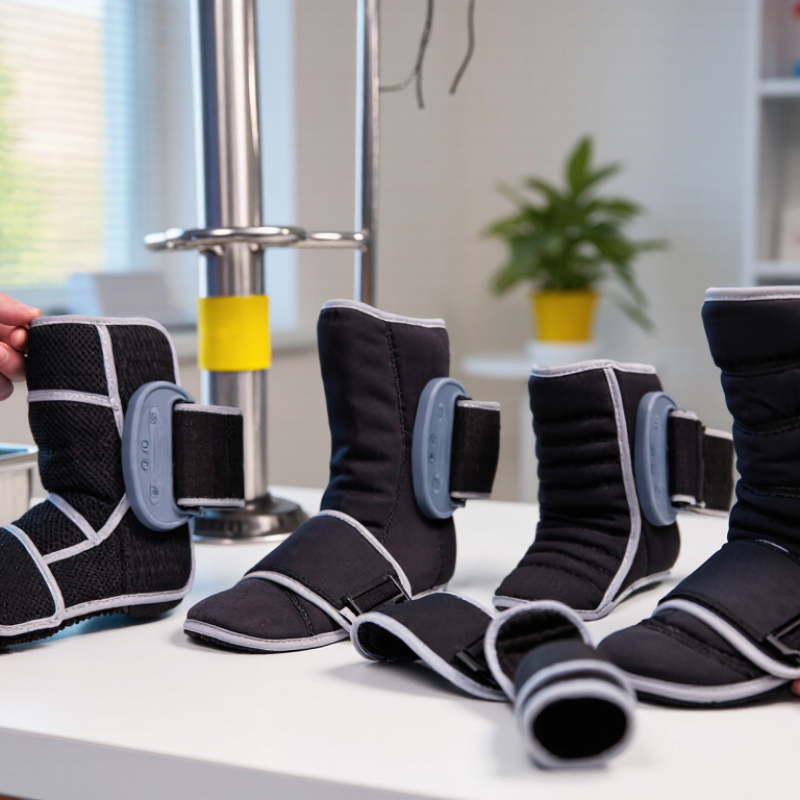
China Top Foot And Ankle Brace Manufacturers?

What Makes a Foot and Ankle Brace Manufacturer a Top Choice in China?

A top foot and ankle brace manufacturer in China combines clinical understanding with consistent production control. The best factories study ankle anatomy, movement patterns, and common recovery needs before developing a brace. They use measured support zones, breathable fabrics, and secure fasteners that remain comfortable during daily activity.

Reliable manufacturers provide material records, test reports, and clear quality procedures. They inspect stitching, compression strength, sizing accuracy, and skin-contact surfaces. Experienced teams also communicate openly about production limits, lead times, and product adjustments. That honesty matters. A perfect sample does not always guarantee stable bulk production, so buyers should review repeated inspection results.

Tips: Ask for size charts, material details, and test evidence. Request samples from different production batches. Check whether the brace stays in place after walking, climbing stairs, or sitting for long periods. Consult qualified medical professionals when support needs involve injury or recovery. Comfort can be subjective, and one design may not suit every user. Manufacturers willing to discuss complaints and improve weak details often deserve closer attention.

What Makes a Foot and Ankle Brace Manufacturer a Top Choice in China?

Regulatory milestones and quality frameworks buyers should consider when evaluating manufacturers

The chart uses official publication or implementation years for internationally recognized quality and regulatory frameworks relevant to medical-device manufacturing. A top-choice manufacturer should be able to demonstrate an appropriate quality management system, risk-management process, and market-specific regulatory readiness. These milestones are reference points, not company rankings or performance scores.

Key Types of Foot and Ankle Braces Produced by Chinese Manufacturers

Chinese foot and ankle brace manufacturers produce several practical designs for different injuries and daily needs. Ankle stabilizers often use elastic compression, adjustable straps, and side supports. They can help manage mild sprains, swelling, and joint instability during walking. Lace-up braces provide a closer fit and allow users to control pressure around the ankle. Support must stay practical.

Hinged ankle braces include rigid side frames that limit unwanted rolling while preserving forward movement. They are commonly used during rehabilitation after ligament injuries. Walking boots offer stronger protection for fractures, severe sprains, and post-operative recovery, but their weight can affect balance. Plantar fasciitis night splints hold the foot in a gentle dorsiflexion position. Compression sleeves are lighter and suit sports, travel, or everyday swelling.

Experienced Chinese manufacturers usually combine neoprene, breathable mesh, molded plastic, aluminum stays, and medical-grade fasteners. Reliable factories should verify stitching strength, strap durability, skin contact, and size consistency. Sampling matters. A product may look excellent but feel uncomfortable after two hours. I have found that accurate measurements often matter more than extra padding. Clinician feedback can improve the support angle and pressure distribution. However, brace selection still depends on the injury, activity level, and medical advice. Not every “stabilizing” design provides enough protection for serious damage. Manufacturers should state intended use clearly and avoid exaggerated recovery claims.

Leading Chinese Manufacturers and Their Product Specialties

China Top Foot And Ankle Brace Manufacturers?

China’s leading foot and ankle brace manufacturers serve hospitals, rehabilitation clinics, sports retailers, and private-label buyers. Their specialties differ. Some focus on lightweight elastic supports for mild sprains. Others produce hinged braces, walking boots, and rigid stabilizers for post-injury care. WHO reports that 1.71 billion people live with musculoskeletal conditions worldwide. That demand supports continued investment in orthopedic support products.

Many established Chinese factories combine injection molding, neoprene cutting, metal hinge assembly, and automated stitching. Better facilities usually maintain ISO 13485-based quality systems and test pressure, durability, skin contact, and repeated bending. A 2024 Grand View Research assessment describes steady growth in the global orthopedic braces and supports market through 2030. However, production scale does not guarantee clinical suitability. A low unit price can hide inconsistent sizing. I have seen specifications that looked complete but lacked clear load-testing details.

Tips: Ask for material certificates, dimensional charts, batch records, and test reports. Confirm whether the brace supports inversion control, compression, or immobilization. Request samples in several sizes. Measure calf and ankle fit carefully. Do not judge comfort from photographs alone. Some product descriptions still need clearer translation. That small weakness deserves attention.

Quality Standards, Materials, and Manufacturing Capabilities

China’s top foot and ankle brace manufacturers should be judged by evidence, not catalog variety. The World Health Organization reported that 1.71 billion people live with musculoskeletal conditions worldwide. This creates demand for reliable, adjustable support products.

Quality begins with documented systems. Check ISO 13485 certification, incoming material inspection, batch traceability, and corrective-action records. Suppliers should also provide testing for compression, fatigue, seam strength, skin contact, and dimensional stability. The FDA’s medical-device quality guidance emphasizes risk control throughout design and production. ISO 10993 biological evaluation is important when braces contact skin for extended periods. Certification alone is not enough. Some audits still miss daily production weaknesses.

Material choices affect comfort and performance. Neoprene offers warmth and flexibility, while breathable knitted fabrics reduce moisture buildup. Thermoplastic components can improve ankle control, but poorly finished edges may cause pressure points.

Strong hook-and-loop closures need repeated-cycle testing. Manufacturing capability should include digital pattern cutting, heat molding, ultrasonic welding, clean assembly areas, and final inspection. Grand View Research’s 2024 orthopedic braces and supports market report highlights material innovation and product quality as major market factors.

Tips: Request recent test reports, not only certificates. Visit the production line if possible. Compare three production samples after washing and repeated use. Ask how rejected units are recorded. A low quotation may reflect thinner materials or weaker inspection, though price alone never proves quality.

How to Evaluate and Select a Chinese Brace Manufacturer

China Top Foot And Ankle Brace Manufacturers?

How to Evaluate and Select a Chinese Brace Manufacturer

Selecting a Chinese foot and ankle brace manufacturer requires more than comparing prices. Request the factory’s business license, quality certifications, and medical-device production qualifications. ISO 13485 certification can indicate a controlled quality system, but it is not proof of every product’s performance. Ask for recent audit records, material specifications, and test reports that match your intended market.

Inspect the brace sample closely. Check stitching around the ankle, hook-and-loop strength, edge finishing, padding thickness, and skin-contact materials. Ask whether production uses documented sizing tolerances. A reliable manufacturer should provide batch records, incoming-material checks, and a clear process for handling defects. Request samples from different production lots, not only a carefully prepared showroom sample.

That sample may mislead you.

During factory evaluations, I have seen attractive prototypes fail after repeated fastening. This is why practical wear testing matters. Ask testers to walk, climb stairs, and wear the brace for several hours. Record pressure points, slipping, odor, and restricted movement. Review complaint procedures and replacement policies before placing an order. Communication also deserves testing. Send a detailed specification sheet and judge how accurately the factory responds. If answers remain vague, production may become difficult later. A smaller initial order can expose weaknesses before larger commitments. Even experienced buyers sometimes overlook packaging humidity controls or inconsistent carton labeling. These details seem minor, but they can damage traceability and customer trust.

China Top Foot And Ankle Brace Manufacturers? - How to Evaluate and Select a Chinese Brace Manufacturer

Evaluation Dimension Recommended Benchmark or Requirement Verification Documents or Methods Suggested Weight Priority
Quality Management System An effective ISO 13485 quality management system is strongly preferred for manufacturers producing medical devices. The certificate should cover the relevant product scope and manufacturing site. Request the current ISO 13485 certificate, issuing-body details, covered site address, scope, expiry date, and recent audit information. Verify the certificate directly with the certification body where possible. 15% High
Regulatory Classification and Market Access The regulatory pathway depends on the intended market, product design, claims, and risk classification. A manufacturer should be able to provide a documented technical file and support applicable registrations or conformity assessments. Review the product classification rationale, declaration of conformity, technical documentation index, labeling, instructions for use, and market-specific registration evidence. 15% High
Material Safety and Biocompatibility Materials that contact skin should be controlled for safety, including textiles, foams, plastics, metals, adhesives, dyes, and coatings. Testing should be appropriate to the duration and type of contact. Check material specifications, supplier declarations, restricted-substance controls, skin-contact risk assessment, and applicable biocompatibility test reports such as ISO 10993-based evaluations. 12% High
Product Design and Functional Performance The brace should provide the intended support, stabilization, compression, or motion limitation without creating unnecessary pressure points or restricting circulation. Product specifications should define measurable performance requirements. Review drawings, size charts, design inputs, functional test methods, pressure or support testing where applicable, user feedback, and design-verification records. 12% High
Sizing and Fit Consistency Size ranges should be based on clearly defined ankle, foot, calf, or instep measurements. Tolerance limits should be documented so that repeat orders remain consistent. Compare approved samples with measurement charts, inspect production tolerances, conduct fit checks on representative users or mannequins, and verify left/right versions where relevant. 8% High
Production Capacity and Lead Time Capacity should be demonstrated using actual production records rather than stated maximum output. The supplier should provide realistic sampling, bulk-production, and replenishment lead times. Request monthly capacity ranges, current utilization, production schedules, bottleneck information, sample lead time, bulk lead time, and on-time-delivery history for comparable products. 10% High
Incoming Material and Process Controls Critical components should be traceable from approved suppliers through incoming inspection, production, final inspection, and shipment. Special processes should have documented control parameters. Audit incoming-inspection records, approved-supplier lists, work instructions, in-process inspection plans, lot coding, final inspection reports, and nonconformance procedures. 8% High
Testing and Inspection Capability The factory should have calibrated equipment and documented test methods for dimensions, stitching, fastening systems, material properties, colorfastness, durability, and packaging integrity as applicable. Review equipment lists, calibration certificates, test records, acceptance criteria, sampling plans, laboratory qualifications, and the division between internal and outsourced testing. 7% Medium
Customization and Engineering Support A capable supplier should support adjustments to materials, closure systems, support levels, colors, packaging, labeling, and private-label specifications without losing design control. Evaluate the engineering team, drawing-change process, prototype capability, sample revision control, tooling ownership, minimum order quantities, and development milestones. 6% Medium
Traceability and Complaint Handling Each production lot should be traceable to materials, operators or production records, inspection results, and shipment information. Complaints should be investigated with documented corrective action. Review lot-number rules, retention-sample policy, complaint logs, root-cause analysis, corrective-action reports, recall procedures, and response-time commitments. 5% High
Packaging, Labeling, and Shipping Protection Packaging should protect the brace from contamination, moisture, deformation, and abrasion during storage and transport. Labels should match the approved product and destination-market requirements. Inspect packaging specifications, drop or transit testing where appropriate, carton markings, barcode accuracy, storage conditions, shelf-life rationale, and shipping documentation. 4% Medium
Commercial Reliability and Total Cost The lowest unit price should not be the only selection criterion. Compare total cost, including tooling, testing, packaging, quality inspections, freight, payment terms, warranty support, and potential rework. Use a written quotation with Incoterms, price validity, tooling ownership, payment schedule, quality terms, warranty conditions, replacement policy, and landed-cost calculation. 5% Medium
Factory Audit and Sample Approval A pre-production sample and documented approval should be completed before bulk manufacturing. An on-site or independent audit is recommended for higher-risk or long-term projects. Complete a factory audit, compare the audited address with certificates and invoices, approve a golden sample, define acceptable quality limits, and record all pre-production corrections. 3% High

We use cookies to ensure that we give you the best experience on our website.